
Use a space heater safely in New Orleans by keeping three feet clear around it, plugging it straight into a wall outlet, and switching it off whenever you leave the room or go to sleep. If a heater starts a fire, get out, call 911, then call Get Restoration New Orleans at (504) 520-4646 for fire and smoke cleanup.
Key takeaways
- Keep anything that can burn at least three feet away from a space heater at all times.
- Plug a space heater directly into a wall outlet, never into an extension cord or power strip.
- Switch the heater off and unplug it when you leave the room or go to bed.
- Place the heater on a flat, hard, stable surface, out of walkways and away from water.
- Test smoke alarms before heating season, and never use an oven or grill to heat your home.
- A heater that smells of burning, trips a breaker, or has a damaged cord should be unplugged and not used again.
Why do space heaters cause fires in winter?
Space heaters are not dangerous on their own. Most problems come from how they are used. A curtain drifts closer as a room warms up. A blanket slips off a bed. A heater ends up behind a chair, or on a rug, or sharing a power strip with other appliances. Each of those small choices closes the gap between heat and something that can catch fire.
Heating season also arrives in homes that have not used a heater for months. Dust has settled on the element, and a cord may have been bent behind furniture. A quick check before the first cold night catches those problems while they are still easy to fix.
Cold fronts are moving through southeast Louisiana this week, with cooler mornings expected later in the week, so households are starting to warm single rooms with portable heaters.
Where should you place a space heater?
Start with the surface. Put the heater on a flat, hard, non-flammable surface, such as a tiled or wooden floor, where it cannot tip over easily. Do not place it on a rug, a bed, a sofa, or a shelf. Keep it out of walkways so nobody trips over it or knocks it over, and never block an exit with a heater.

Then check the three-foot rule. Keep bedding, curtains, furniture, clothing, paper, and pet beds at least three feet away from the front, sides, and back of the heater. Measure it once, rather than guessing. Three feet is roughly an arm’s length plus a step, and it is the distance fire agencies recommend for all heating equipment.
Children and pets need the same boundary. Keep a three-foot kid- and pet-free zone around the heater, and never place a heater close to a sleeping person. If a room is so small that three feet of clearance is impossible, that room is not the right place for a portable heater.
How should you plug in a space heater?
Plug the heater directly into a wall outlet. Space heaters draw a large amount of power, and an extension cord or power strip can overheat under that load. Do not run the cord under a rug or carpet, where heat builds up unseen and damage goes unnoticed.

Check the cord before the first use each season. Look for fraying, cracking, melted spots, or a plug that feels loose in the outlet. If the outlet or plug feels hot during use, switch the heater off, unplug it, and do not use that outlet for the heater again until it has been checked.
If a breaker trips when the heater runs, treat that as a warning, not an annoyance. Move the heater to a different circuit, and do not keep resetting the breaker. A circuit that trips repeatedly is telling you it is overloaded.
Which heater is safest to buy?
Choose a heater that carries a recognised safety mark, such as UL or ETL, and that has been tested to current safety standards. Look for a thermostat, overheat protection that switches the heater off if it gets too hot, and an automatic tip-over switch that cuts power if the heater falls over.
Avoid second-hand heaters with no label, no manual, and no safety features. If you cannot confirm a heater has tip-over and overheat protection, replace it.
Fuel-burning heaters need extra care. Only use a fuel-burning heater indoors if it is designed and approved for indoor use, and make sure the room has ventilation and a working carbon monoxide alarm. Never use a gas oven, stove, grill, or generator to heat a home: those appliances can produce carbon monoxide, a gas you cannot see or smell, and can be deadly in an enclosed space.
What daily habits keep a space heater safe?
Switch the heater off every time you leave the room, and always before you go to sleep. This is the single habit that prevents most heater fires. A heater left running overnight, or in an empty room, has nobody nearby to notice a curtain falling, a pet knocking it over, or a smell of burning.
Keep the heater clean. Dust the grille and element regularly, following the manufacturer’s instructions, and never cover a heater with clothing to dry it. Do not use a space heater in a damp area, such as a bathroom, unless it is specifically designed for that use.

Test your smoke alarms at the start of heating season, and monthly after that. Put smoke alarms on every level of the home, outside sleeping areas and inside each bedroom. If you use any fuel-burning heating, add carbon monoxide alarms as well, and replace batteries or the unit itself if a test fails.
What should you do if a space heater catches fire?
Do not try to carry a burning heater outside, and do not pour water on an electrical fire. If the fire is small and you have a fire extinguisher and know how to use it, you may try from a safe distance. Otherwise, get everyone out of the house, close doors behind you if you can, and call 911 from outside.
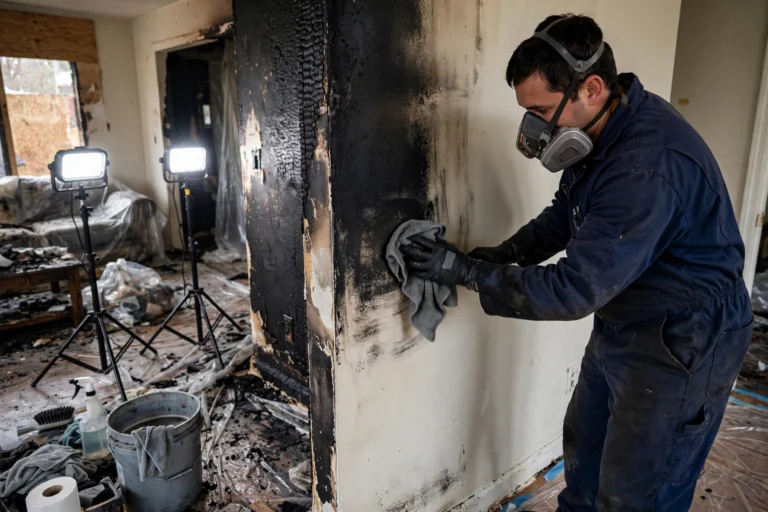
After the fire service has left, do not move back in and start cleaning until the damage has been assessed. Smoke and soot travel well beyond the room where the fire started, settling into walls, ductwork, and soft furnishings. Our team handles fire damage restoration across Greater New Orleans, including soot removal and odour treatment. If the smell lingers after a first clean, our guide to smoke odor removal explains why hidden soot is usually the cause, and the steps after any house fire are covered in our smoke damage cleanup guide.
Photograph the heater, the outlet, and any damaged surfaces before cleanup, and keep receipts for emergency work. A clear record from the first hour makes any later insurance claim far simpler.
Space heater safety checklist
- Keep three feet clear around the heater, on all sides.
- Plug it straight into a wall outlet, never into an extension cord or power strip.
- Place it on a flat, hard, stable surface, out of walkways.
- Switch it off and unplug it when you leave the room or go to bed.
- Check the cord and plug for damage before heating season.
- Test smoke alarms, and add carbon monoxide alarms for fuel-burning heat.
- Never use an oven, grill, or generator to heat your home.
- If a heater smells of burning, trips a breaker, or has a damaged cord, stop using it.
A space heater should make one room more comfortable, not add risk to the whole house. Three feet of space, a direct wall outlet, and switching it off when you leave cover most of that risk. If a heater fire does happen, Get Restoration New Orleans responds 24/7 at (504) 520-4646 to help your home get back to normal.
Frequently asked questions
Can I leave a space heater on overnight?
No. Switch a space heater off and unplug it before you go to sleep. A heater running overnight has nobody nearby to notice a curtain falling onto it, a pet knocking it over, or a burning smell, and most heater fires happen when the heater is left unattended.
Is it safe to plug a space heater into an extension cord?
No. Plug a space heater directly into a wall outlet. Heaters draw a large amount of power, and an extension cord or power strip can overheat. Never run a heater cord under a rug or carpet, where heat and damage go unseen.
How far should a space heater be from furniture and curtains?
Keep anything that can burn at least three feet away from the heater on all sides, including bedding, curtains, furniture, clothing, and paper. Keep children and pets three feet away as well, and never place a heater close to a sleeping person.
What should I do if my space heater smells like burning?
Switch it off, unplug it, and do not use it again until you know the cause. A burning smell can mean dust on the element, but it can also mean a damaged cord, an overloaded outlet, or an internal fault. If the smell continues with a clean, undamaged heater, replace the heater.
Should I call a restoration company after a space heater fire?
Call one if soot has reached walls, ceilings, or cabinets, if the smell lingers, or if water was used to put the fire out. A restoration team can assess hidden soot and moisture, clean surfaces properly, and document the damage for insurance.